1839: The Birth of an Adventure
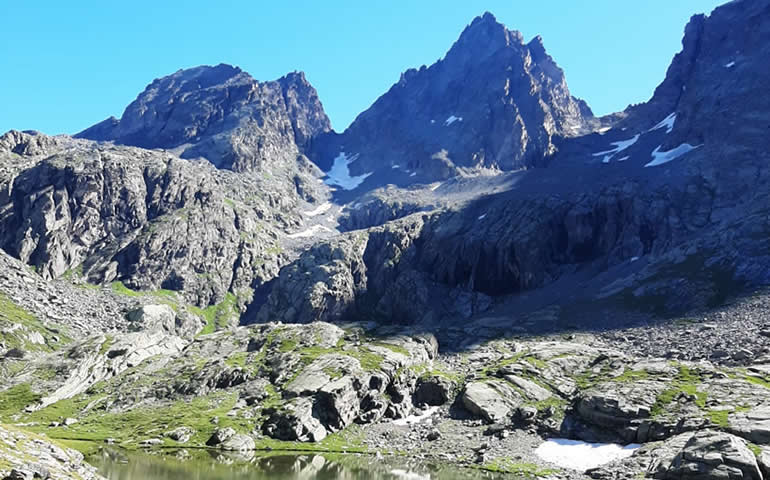
The Giro del Viso
Did you know that multi-day trekking around a mountain peak was born right at the foot of Monviso? It was 1839 when James David Forbes, professor of natural philosophy at the University of Edinburgh, embarked on a long journey through the Alps. Coolidge recounted: “From Marseille he began his route, following the valleys of the Durance and Ubaye up to Barcelonnette, crossed the head of that valley via the Col de la Cula, reaching Saint-Véran and then Abriès in the Guil Valley […] He made the ‘Tour of Monte Viso’ through many challenging passes: the Col des Traversettes, the Col di Viso, the Passo delle Sagnette or San Chiaffredo, and Vallante.” To reach the “Waldensian Valleys of Piedmont,” Forbes then descended along the Guil to L’Échalp, completing the Tour of Monte Viso exactly as thousands of French hikers do today.
The Giro del Viso became truly famous in the 1970s as the “Tour du Mont Viso”: it was indeed the French who rediscovered this route. Curiosity, or perhaps the excellent cuisine of the Italian refuges, or simply the extraordinary beauty of the landscape, brought thousands of French hikers around Monviso. In the following years, the number of Italians also increased, as well as Germans, Dutch, and Swiss, who discovered the Giro del Viso thanks to the Grande Traversata delle Alpi.
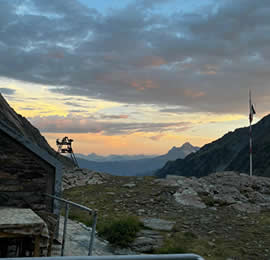
Few treks offer such spectacular views of all sides of the mountain while simultaneously overlooking three different valleys: Po, Varaita, and Guil. Elevation changes are always moderate, and you never lose too much altitude: from the 2,000 meters of Pian del Re, you descend only once to 1,937 meters, and then enjoy a fantastic walk across passes between 2,655 meters at Colle di Viso and 2,947 at Colle delle Traversette. Elevation changes are also manageable starting from 1,590 meters at Castello, the hamlet of Pontechianale where the tour begins in Val Varaita, or from 1,787 meters at Roche Ecroulée in the Queyras Natural Park. The first day can be completed in half a day, regardless of which valley you start from; the presence of the five refuges around the “Giant of the Cottian Alps” allows hikers to plan the following stages freely.
For those who enjoy “variants,” and for those starting from Pontechianale or the Queyras, there is the interesting “Postman’s Path”: a panoramic mid-slope trail along the cliffs of Punta Roma and Punta Venezia, between Lago Chiaretto, the Giacoletti Refuge, and the Col des Traversettes, which avoids descending to Pian del Re. While this variant offers a shortcut, some choose to extend the trek toward Val Pellice. From the refuge du Mont Viso, one can reach the Granero Refuge via Col Selliere, the Jervis in the beautiful Prà basin, or even the Barbara Refuge. The Alpetto Refuge, built near the historic 1866 construction and not far from the Sella Refuge, provides hikers with an additional overnight option.
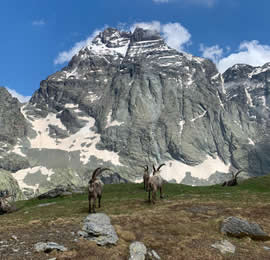
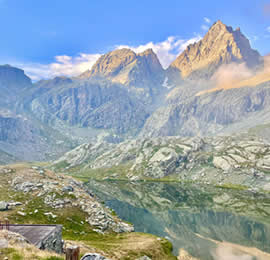
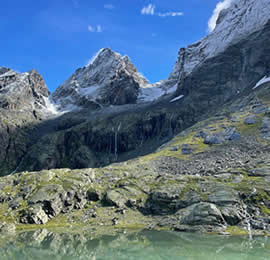
Views of Monviso
Evolution of the Giro del Viso
-
1839
James David Forbes completes the first “Tour of Monte Viso”
-
1970ss
The French rediscover the Giro: the “Tour du Mont Viso” is born
-
Following years
Hikers from Italy, Germany, the Netherlands, and Switzerland make it international
The "Buco di Viso"
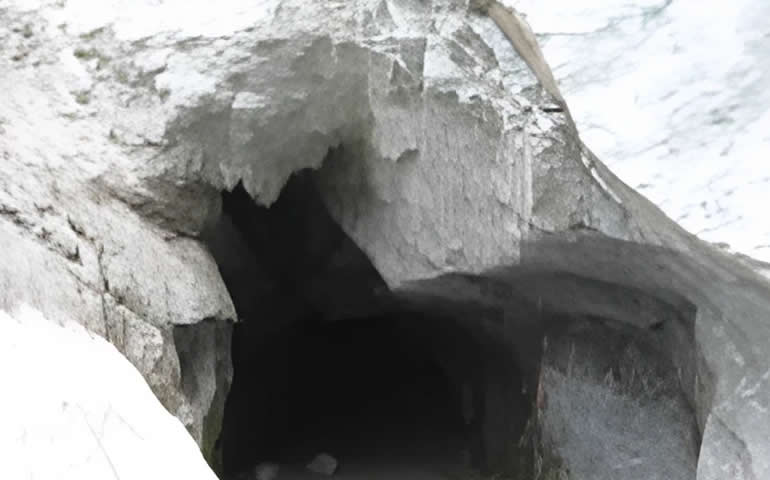
It is also possible to complete the Giro di Viso route through the “Buco di Viso,” a tunnel built between 1475 and 1480 just below the Colle delle Traversette. It is about 75 meters long, 2 meters high, and 2.5 meters wide. The project was commissioned by Ludovico II, who sent an official request to the Parliament of Grenoble to create a gallery that would facilitate passage between his lands and the Dauphiné. Since the response was slow in coming, in 1477 the marquis decided to write directly to King Louis XI of France and to Jean d’Aillon, governor of the Dauphiné. The economic agreement was then established between the Dauphiné and the Marquisate of Saluzzo, allowing and facilitating trade, especially of salt, using mules.
Trade between the two alpine valleys (connected for the first time by a tunnel) intensified, benefiting local populations. Unfortunately, after goods came armies, and the “Buco” gained strategic importance. Today, the “Buco di Viso” is a destination for scholars and hikers who climb there to admire this remarkable piece of engineering that has connected the Po Valley with the French Guil Valley for over five centuries.
The Tunnel That Made History
-
1475
Start of the tunnel construction under the Colle delle Traversette
-
1480s
End of the works: the Buco di Viso connects the Po and Guil Valleys
-
1700+
The tunnel gains strategic importance for military movements
-
Today
Hiking destination and testimony to historical engineering